
Easter is one of the most underutilised opportunities in the early years calendar. While the season reliably fills nursery windows with cotton wool chicks and pastel egg collages, the deeper developmental potential — across communication and language, mathematics, physical development, expressive arts, and understanding the world — is consistently left untapped. That gap is not down to practitioner skill or commitment. It is down to time, and the conditions in which early years planning actually happens. This article makes the case that Easter, when approached with genuine developmental intent rather than seasonal habit, becomes a vehicle for meaningful progress across every area of the EYFS framework. That shift does not require more effort — it requires smarter planning. The sections that follow move through each key domain: sensory play, creative arts, storytelling and language, mathematics, outdoor science, and inclusive practice. Each one demonstrates how the familiar Easter context can be reframed not as a seasonal backdrop but as a genuine learning provocation. Whether your setting takes a faith-centred approach to Easter or focuses on spring and new life more broadly, the planning principles here apply. The season is the entry point. Development is the destination.
Why Easter Deserves More Than a Craft Table
Walk into most nurseries in April and you’ll find cotton wool chicks, egg-shaped collages, and pastel-coloured paint prints. None of that is wrong — but if Easter planning stops there, practitioners are leaving significant learning potential on the table.
Easter is one of the most developmentally rich seasonal contexts in the early years calendar, yet it’s routinely reduced to decoration. That’s a habit worth challenging.
The EYFS framework explicitly recognises cultural, religious and seasonal experiences as meaningful vehicles for learning, particularly within Understanding the World. Easter — whether approached through its Christian significance or its broader themes of spring and renewal — directly supports that strand. But the opportunity doesn’t stop there.
Spring’s arrival brings observable change: seeds germinating, animals appearing, daylight extending. These are concrete, sensory experiences that map naturally onto Communication and Language, Expressive Arts and Design, and even early mathematics through pattern, sequencing and comparison.
The key distinction is developmental intent. An egg hunt can be a chaotic five minutes, or it can be a structured exercise in problem-solving, turn-taking and positional language. The activity looks the same; the planning behind it makes all the difference.
Settings vary — some take a faith-centred approach, others focus purely on seasonal themes. Both are entirely valid, and both can be planned with purpose using EYFS-aligned activity frameworks. Start your free trial today.
Sensory Play That Uses Easter as the Entry Point, Not the Destination
Sensory play consistently delivers some of the highest developmental returns of any EYFS activity type. It simultaneously supports Communication and Language (narrating, describing, questioning), Physical Development (fine motor control, hand-eye coordination), and PSED (turn-taking, managing frustration, confidence to explore). Easter, as a season, hands practitioners a ready-made sensory palette — textures, colours, scents, and natural materials — that costs very little to assemble and offers genuine learning potential when used with intent.
The risk is treating Easter objects as decoration rather than provocation. A tray of plastic eggs and shredded paper is not inherently valuable. What makes it valuable is what the practitioner plans around it: the questions they seed, the space they leave for child-led discovery, and the EYFS areas they are consciously targeting.
Setting Up an Easter Sensory Tray With Clear Learning Intent
A well-built sensory provocation starts with the learning goal, not the theme. Here’s a concrete example:
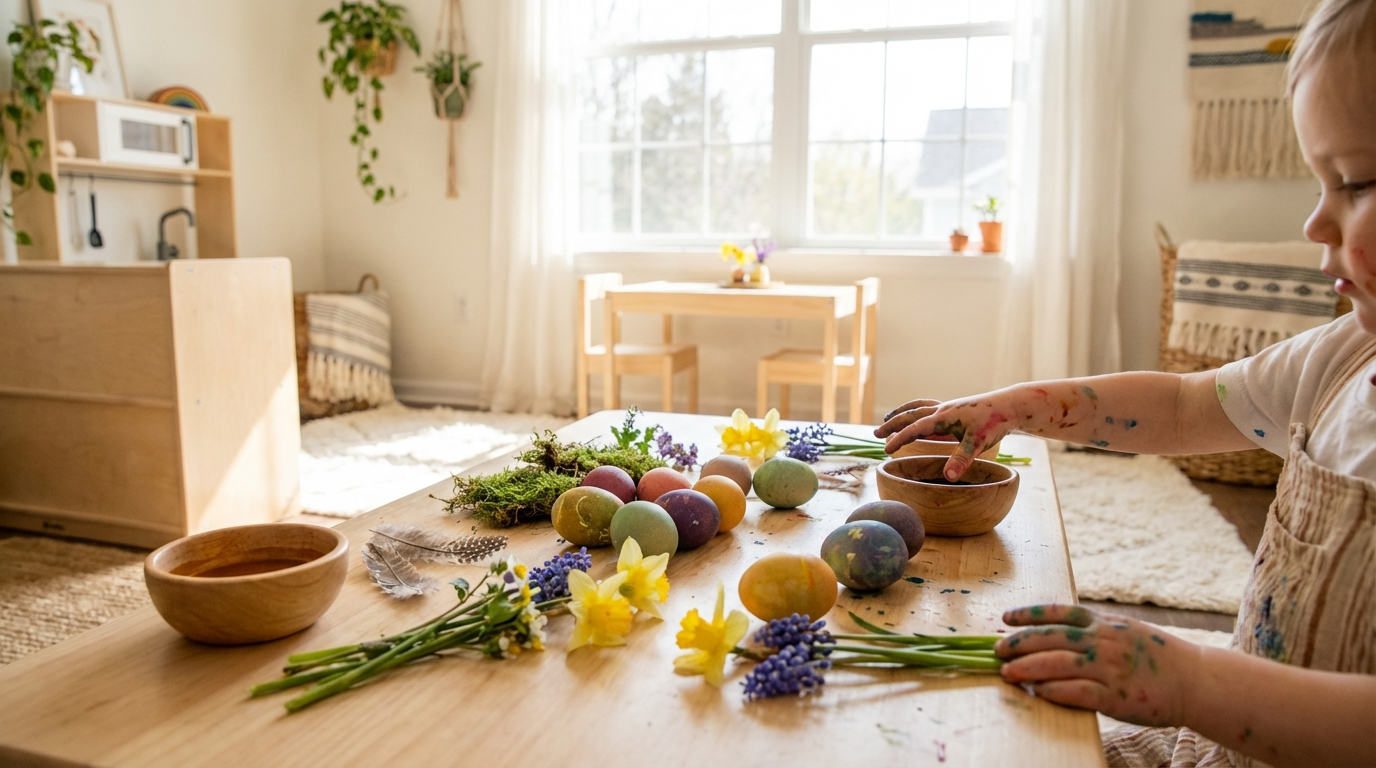
- Materials: Soil, moss, small smooth eggs, feathers, dried petals, and shredded paper ‘grass’
- EYFS links: Physical Development (manipulating small objects), Understanding the World (natural vs. man-made materials), Communication and Language (descriptive vocabulary — rough, soft, damp)
- Practitioner role: Introduce one open question — “What does this feel like?” — then step back and observe before intervening
Mud kitchen spring setups work on the same principle. Add petals, grass, and water to an outdoor mud kitchen and you connect seasonal sensory play directly to the natural environment — which is where it belongs.
The same logic applies to water play with natural materials: moss, bark, and seed pods extend the Easter season into meaningful outdoor learning without forcing a theme.
Over-theming is the trap to avoid. The Easter stimulus should open play up, not fence it in. If children are more interested in the soil than the egg, follow that. The season is the entry point; development is the destination.
If you want a faster route to sensory provocations that already carry explicit EYFS links, explore how PlayPlan generates ready-to-use activity plans — and start your free trial today.
Creative Arts and Crafts That Actually Develop Skills
Most Easter planning defaults to crafts — and that’s fine, but only if those crafts are doing real developmental work. The issue isn’t Easter art itself, it’s the prevalence of product art: pre-cut egg templates, identical finished results, and activities where the practitioner has essentially made all the decisions in advance. That approach offers children very little.
The shift worth making is toward process art. The goal isn’t a perfect decorated egg on the display board — it’s the experience of mixing colours, experimenting with tools, and making independent creative choices. That’s where the learning lives.
- Egg decorating with varied mark-making tools — cotton reels, sponges, fingers, and brushes of different widths — develops fine motor control and gives children genuine agency in Expressive Arts and Design.
- Collage using natural spring materials like petals, leaves, and feathers creates an authentic link between Expressive Arts and Understanding the World. Children are observing texture, colour, and natural patterns, not just sticking things down.
- Easter card making becomes a real communication activity when children compose their own message — even pre-writers can dictate what they want to say. This connects directly to early literacy and personal, social expression.
- Clay or salt dough egg modelling builds spatial awareness, sustained concentration, and physical development in ways that flat activities simply cannot replicate.
Avoid the template trap. Pre-cut Easter shapes handed to a group of children remove almost every meaningful decision from the process. Open-ended materials — paint, clay, natural objects — return that agency to the child, which is where developmental value is generated.
Printing, Patterns and Colour Mixing: Easter as an Art Provocation
Set up a printing provocation using halved vegetables, cotton reels, and sponges alongside two or three primary colours. Invite children to decorate large egg outlines they’ve drawn themselves. Ask open questions: What happens when you mix those two? This single activity covers fine motor development, colour theory exploration, and creative decision-making — and it takes about ten minutes to prepare. For EYFS-aligned activity ideas generated in seconds, PlayPlan can build this kind of provocation into a full session plan. Start your free trial today.
Storytelling and Language Development Through Easter Narratives
Easter is one of the few seasonal themes that arrives with a genuine narrative structure already built in. There is change, discovery, mystery, and resolution — exactly the ingredients children need to engage with stories meaningfully, not just passively. That makes it an unusually strong vehicle for early literacy development.
Narrative Arcs Children Can Actually Follow
Both secular and faith-based Easter stories offer clear story structures. The Easter bunny’s journey, a chick hatching, or the Easter story itself all have beginnings, turning points, and outcomes. These arcs help children practise sequencing, prediction, and the language of time — first, then, next, finally — in a context that feels relevant and exciting rather than abstract.
Provocations That Prompt Language, Not Just Activity
- Story-based provocations: Leave ‘clues’ or notes around the setting from the Easter bunny. Children naturally begin sequencing events, asking questions, and speculating about what comes next.
- Small world play: A tray with chicks, rabbits, eggs, and nesting materials invites children to build their own narratives — one of the most authentic communication and language activities available in EYFS.
- Purposeful mark-making: Easter letters to the Easter bunny, hand-drawn maps to find hidden eggs, or labels for a spring garden all give writing real communicative intent. Children are not practising for practice’s sake.
Choosing the Right Books
Story time should prompt conversation, not just quiet listening. Books like Jasper’s Beanstalk or The Extraordinary Egg open up questioning, prediction, and discussion. The goal is dialogue, not delivery.
These activities map directly onto EYFS Literacy goals — comprehension, word reading readiness, and writing as communication — which means Easter storytelling is curriculum work, not a seasonal extra. If you want ready-made provocations aligned to these goals, explore PlayPlan’s EYFS activity generator and start your free trial today.
Maths and Problem-Solving Woven Into Easter Play
There’s a tendency to reach for Easter as a prompt for crafts, storytelling, and language activities — and those connections are valid. But Easter is also one of the richest natural contexts for early mathematical thinking, and it’s one practitioners frequently underuse. The seasonal theme gives maths a purpose children can feel, which is exactly what makes abstract concepts stick.
Using an Egg Hunt as a Structured Mathematical Investigation
An egg hunt doesn’t have to be a chaotic free-for-all. When structured intentionally, it becomes a genuine mathematical experience. Before children head out, give each child a specific number of eggs to find — this immediately introduces one-to-one correspondence and subitising. When they return, prompt comparison: “Who found more? How do you know? Can we check?” That’s reasoning, not just recall.
Sorting activities are equally powerful and easy to overlook. Provide eggs in different colours, sizes, or patterns and ask children to organise them. This develops early classification skills and builds the mathematical vocabulary — bigger, smaller, the same, different — that underpins later number work.
Open-ended provocations push thinking further. Place a basket on the table and ask: “How many eggs do you think will fit? How could we find out?” This moves children from performing maths to doing it, which is a meaningful distinction at EYFS stage.
Baking Easter biscuits or nests brings in measurement and sequencing. Following a recipe requires children to think about quantity, order, and time — that’s mathematical thinking embedded in a practical, motivating context.
- Counting and comparing eggs develops number sense naturally
- Sorting by attribute builds classification and vocabulary
- Recipe-following reinforces sequencing and measurement
- Open questions encourage reasoning rather than rote answers
If you want activities like these planned quickly and mapped directly to EYFS outcomes, explore how PlayPlan generates maths-rich Easter activities for your setting — or start your free trial today.
Nature, Science and the Outdoors: Easter as a Gateway to Spring Inquiry
Easter lands at arguably the most scientifically interesting moment in the early years calendar. The natural world is visibly changing — buds are opening, temperatures are shifting, days are noticeably longer, and new animal life is appearing. Most practitioners acknowledge this in passing. The better approach is to plan for it deliberately, using Easter as a structured entry point into genuine scientific inquiry across Understanding the World and beyond.
This is not about Easter-themed science worksheets. It is about taking children outside, giving them a reason to look closely, and building the kind of sustained observation habits that the EYFS framework is explicitly designed to support.
The Easter Garden Project: A Week-Long Learning Provocation
One of the most effective Easter EYFS activities is the Easter garden — and the key is treating it as a week-long provocation rather than a single afternoon craft. Here is a practical structure that works in most nursery settings:
- Day 1 — Gathering: Take children on a short outdoor walk to collect natural materials: moss, small stones, twigs, fallen petals. Talk about what they are finding and where it comes from. This builds vocabulary and grounds the project in real observation.
- Day 2 — Building: Use a shallow tray or seed tray filled with soil. Children arrange their collected materials, add small bulbs or fast-germinating seeds such as cress or mustard, and water them. Introduce language around growth, soil, roots and sunlight.
- Day 3 and 4 — Observing: Children revisit the garden daily. Give them simple observation prompts — has anything changed? What does the soil feel like? Is it lighter or darker today? Use this as a daily communication and language activity, not just a science one.
- Day 5 — Documenting: Children use tablets or cameras to photograph their gardens. Comparing the Day 1 and Day 5 images creates a concrete visual record of change over time — directly supporting Understanding the World goals around life cycles and natural processes.
The photography element is worth expanding. When children are given agency over documenting change, they develop observational language organically. They need words to describe what they see. This creates a natural bridge between outdoor science and Communication and Language development — something that EYFS activity planning can often miss when the two are treated as separate domains.
Minibeasts, Mud and Making Sense of Spring
Alongside growing activities, spring minibeast exploration is one of the highest-value outdoor science experiences available to early years practitioners at Easter. Worms, beetles, woodlice and early butterflies are all appearing, and children’s natural curiosity about them is high.
Structure this deliberately. Give children magnifying glasses and a simple observation sheet with pictures rather than words — drawing what they find, noting where they found it, counting legs. This is early biological science. It also supports fine motor development and, when discussed in a group, drives sustained shared thinking.
A few practical points worth stating clearly:
- Wet and muddy conditions are not a barrier — they are an asset. Soil turning, worm-finding and puddle observation are all scientifically rich activities.
- The chick lifecycle deserves more than a poster on the wall. Whether through high-quality picture books, age-appropriate video or — where possible — a visit to a farm or petting event, understanding how chicks hatch is a concrete, memorable introduction to biological change.
- Spring weather itself is curriculum content. Why are the days longer? Why are plants growing now and not in December? These questions, scaffolded appropriately, build genuine scientific curiosity rather than rote seasonal awareness.
- The outdoor environment should not be treated as secondary to indoor activities. For many EYFS children, outdoor Easter activities are more developmentally productive than anything that happens at a craft table.
If your setting is still treating the outdoor space as a supplement rather than a core learning environment, Easter is a practical moment to shift that. The season justifies it, the children respond to it, and the EYFS framework supports it. If you want structured support building this kind of outdoor EYFS planning into your practice efficiently, start your free trial today.
Planning Easter Activities Inclusively: Faith, Culture and Sensitivity
Easter carries both religious and secular weight, and practitioners often default to one without thinking it through. That default matters. In a multi-faith setting, leading with chocolate eggs and spring chicks is usually fine — but it should be a conscious choice, not habit.
Framing for Diverse Settings
Anchoring Easter activities around spring, new life and seasonal change lets every child participate meaningfully. Observing frogspawn, planting seeds, or talking about what animals do after winter — these are genuinely inclusive framings that don’t erase the occasion or feel tokenistic.
Where Easter’s Christian significance is relevant to your setting or community, the Easter story can be introduced through Understanding the World activities in EYFS in age-appropriate ways. Talking about what the story means to some families, and why people celebrate, is exactly the kind of respectful curiosity EYFS encourages.
Practical Sensitivity: Food and Allergies
Any baking or chocolate activity needs a dietary and allergy review before the planning stage closes — not as a last-minute check. This includes:
- Nut and dairy allergies common in chocolate-based crafts
- Dietary restrictions based on religious observance
- Alternatives prepared in advance, not improvised on the day
Handling this well models something valuable in itself. Under Personal, Social and Emotional Development in EYFS, children learn respect for difference by watching practitioners demonstrate it. Inclusive Easter planning isn’t a compliance exercise — it’s a teaching opportunity. Start your free trial today to generate activities already built with inclusion in mind.
The Planning Problem: Why Easter Activities Often Fall Short
Let’s be honest about how most Easter planning actually happens in early years settings. A practitioner finds a cute chick craft on Pinterest at 8pm, prints it off, and that becomes the week’s seasonal activity. It looks lovely on the wall. Parents smile. But developmentally? It was a cutting and sticking exercise with an Easter wrapper.
This isn’t a criticism of practitioners — it’s a criticism of the conditions they’re working in. Seasonal planning rarely gets dedicated time. It gets squeezed into the margins between key person check-ins, observations, parent communications, and the general weight of early years administration. Something has to give, and unfortunately it’s often the depth of the planning.
The real cost isn’t wasted craft materials. It’s a missed window. Easter falls at a point in the year when children are developmentally more settled, more confident, and more ready to engage with richer experiences. A poorly planned activity doesn’t just fail to add value — it uses up time that could have delivered genuine progress across communication, fine motor skills, mathematical thinking, or personal development.
The answer isn’t to plan harder. It’s to plan smarter. When practitioners have access to EYFS-aligned Easter activity ideas that are already structured around learning outcomes, they can focus their energy on delivering a quality experience rather than building one from scratch at the last minute.
This is exactly what PlayPlan is built for. Its AI-powered platform generates customised, EYFS-aligned activities — Easter themes included — in minutes rather than hours. Start your free trial today and see how much time you can reclaim during your Easter planning.
Making Easter Count: A Practical Summary for Practitioners
The central argument running through every section of this article is straightforward: Easter is not a theme to be applied on top of learning. It is a context through which learning can happen — provided the planning behind it is intentional rather than incidental.
What that looks like in practice will differ by setting. A nursery in a faith community may draw directly on the Easter story as a vehicle for Understanding the World, language development, and values. A secular setting may lean entirely into spring, new life, and the natural world. Both approaches are legitimate. Both can deliver genuine developmental progress. The deciding factor in either case is whether the practitioner — or the team — has had the time and the tools to plan with real EYFS alignment, rather than defaulting to seasonal decoration.
The trade-offs here are real. Sensory provocations take setup time that busy practitioners often do not have. Outdoor science requires weather contingencies, risk assessments, and adult ratios that small settings may find difficult to manage. Inclusive planning adds a layer of consideration — dietary checks, cultural sensitivity, faith awareness — that can feel burdensome when planning is already squeezed. None of these barriers are reasons to abandon ambition. They are reasons to plan efficiently.
The most productive shift any early years team can make is separating the question of what to plan from the question of how to plan it quickly. The developmental case for rich Easter EYFS activities is clear, well-supported by the EYFS framework, and borne out by what practitioners observe in children every spring. The practical challenge is generating that quality of planning at speed, consistently, without burning out the people responsible for delivering it.
That is precisely the problem PlayPlan is designed to solve. By generating customised, EYFS-aligned activity plans in minutes — Easter sensory trays, maths provocations, outdoor science sequences, inclusive art activities — it removes the administrative weight from planning without removing the practitioner’s professional judgement. You still decide what your children need. PlayPlan helps you get there faster. If you have not yet explored what that looks like for your setting, start your free trial today and spend your Easter planning time on the things that only you can do.