
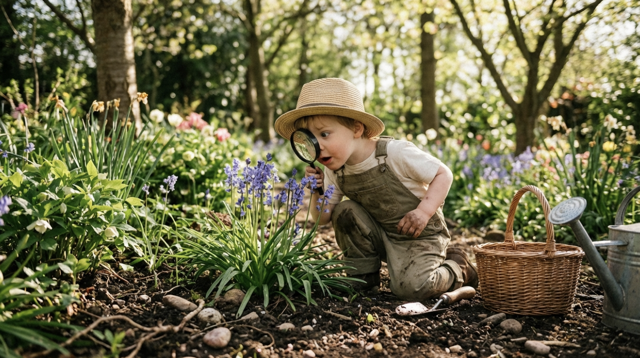
Spring is the most educationally powerful season available to early years practitioners — and most settings squander it. While nature is transforming at a rate children can actually observe, many nursery rooms default to laminated flowers and themed craft tables, mistaking decoration for learning. The gap between what spring offers and what gets planned around it represents one of the most consistent missed opportunities in early years education. Children in this developmental window are primed for exactly the kind of sensory, open-ended, question-driven experience that spring delivers naturally — buds opening, soil warming, insects reappearing, rain collecting in new places. These aren’t background events. They are, when approached with intention, some of the richest curriculum material available under the EYFS framework. This article sets out five structured spring EYFS activity ideas built around real seasonal phenomena, mapped clearly to EYFS outcomes, and designed around child-led conversation rather than adult-directed output. It also examines why this kind of planning consistently falls short in practice, what the EYFS framework actually asks of practitioners during this season, and how building environmental awareness into daily spring routines produces effects that extend well beyond the setting. The thesis is straightforward: practitioners who treat spring as a structured teaching season — not a backdrop for seasonal displays — cultivate children who notice the world and care about it.
Why Spring Deserves More Than a Display Board
Most nursery settings acknowledge spring. Few actually use it. Walk into any early years room in April and you’ll likely find laminated daffodils, cotton wool chicks, and an Easter bonnet on display. That’s not spring learning — that’s spring decoration.
Spring is arguably the richest pedagogical season available to practitioners, and it’s routinely wasted. No other time of year delivers such a concentrated convergence of sensory change, biological transformation, and raw child curiosity. Buds break, soil smells different, birds return, light shifts. Children notice all of it — if you give them space to look.
The EYFS framework practically signals this. Understanding the World asks children to observe, explore, and make sense of natural processes. Expressive Arts and Design invites them to respond to what they experience. Spring feeds both areas directly — but only when activities are intentional rather than decorative.
Research consistently shows that children who engage meaningfully with nature in early years develop stronger observation skills, better emotional regulation, and the early foundations of scientific thinking. Nature isn’t a backdrop for the curriculum. In spring, it is the curriculum.
If your planning isn’t reflecting that yet, explore how EYFS-aligned activity planning can help you build more intentional spring learning — or start your free trial today.
What EYFS Actually Asks of Practitioners in Spring
The EYFS framework doesn’t just accommodate spring-based learning — it practically calls for it. Under Understanding the World, children are explicitly expected to observe plants and animals, notice environmental changes, and articulate what they’re seeing. A morning spent watching buds open or worms surface after rain isn’t a curriculum detour. It’s the curriculum.
The same logic applies across multiple areas. Physical Development is naturally served by digging, balancing on uneven ground, and carrying equipment outdoors. Communication and Language flourishes when children are genuinely excited about something — and spring gives them plenty to be excited about.
Perhaps more importantly, the Characteristics of Effective Learning — particularly playing and exploring and creating and thinking critically — are best expressed in environments that are unpredictable and sensory-rich. A classroom table rarely delivers either. A spring garden does both simultaneously.
Practitioners sometimes feel pressure to justify outdoor time against curriculum targets. That instinct, while understandable, is misplaced. The framework was built with experiential, nature-led learning in mind. The challenge isn’t alignment — it’s planning with enough intention to make the most of what spring offers before it’s gone.
That planning pressure is real, though. Structuring activities that genuinely hit multiple EYFS areas while keeping children engaged takes time most practitioners don’t have. Explore how PlayPlan supports EYFS-aligned activity planning — or start your free trial today.
Five Spring EYFS Activities That Go Beyond the Surface
The best spring activities are not the ones that produce the tidiest display board. They are the ones where children are genuinely absorbed, asking questions you did not expect, and returning to the same experience across multiple sessions. Each of the activities below is built around a real seasonal phenomenon, tied to specific EYFS outcomes, and designed to be conversation-led rather than output-driven.
1. Blossom and Petal Sensory Exploration
Collect fallen blossom, petals, leaves, and bark. Lay them on a light table or a simple white tray outdoors. The aim is not to make anything — it is to look, touch, describe, and compare. This is foundational scientific observation, and it costs almost nothing.
EYFS rationale: This activity directly supports Understanding the World (The Natural World) and Communication and Language. Children are building descriptive vocabulary, noticing patterns, and developing the habit of close attention.
Sensory dimensions: texture, scent, colour gradation, translucency when held to light. Ask children to arrange petals from darkest to lightest. Ask what they think happened to a brown petal that was once pink.
Practitioner prompts: “What do you think this felt like when it was still on the tree?” / “Can you find two that look the same but feel different?” Avoid rushing to name parts. Let children describe before you label.
Honest tip: Resist the urge to turn this into a collage. The moment it becomes a craft, children shift from scientists to decorators. Hold the open-ended space.
2. Minibeast Hunting and Habitat Mapping
Give children clipboards, simple recording sheets, and magnifying glasses. Let them search the outdoor space — under logs, near plant pots, in damp corners — and mark on a basic map where each creature was found. Children own the process; you follow their lead.
EYFS rationale: This builds directly on Understanding the World and supports early mathematical thinking through tallying and recording. It also develops self-regulation through careful, quiet movement.
The key argument here is agency. When children find a woodlouse themselves, it belongs to them in a way that a practitioner-led demonstration never will. That ownership drives genuine curiosity.
Practitioner prompts: “Why do you think we found more under the log than in the sunny patch?” / “What would you need if you were a minibeast living here?” Push beyond identification toward habitat thinking.
Honest tip: Do not over-scaffold the recording sheet. A blank page with a pencil often produces richer documentation than a pre-printed grid.
3. Mud Kitchen Spring Cooking
Mud play is not chaotic. It is structured sensory learning with significant developmental return — fine motor development, imaginative narrative, language, and emotional regulation all emerge naturally. In spring, extend the mud kitchen with foraged additions: blossom, grass, water from a rain collector, soil of different textures.
EYFS rationale: Expressive Arts and Design, Physical Development (fine motor), and Communication and Language. Children narrate their play constantly in a mud kitchen — that language is rich and worth capturing.
Practitioner prompts: “What does your soup need to smell nicer?” / “How will you know when it’s ready?” / “What happened to the mud when you added more water?” These questions elevate play into early scientific thinking without breaking the imaginative frame.
Honest tip: Stay near but do not direct. Your presence signals value; your silence gives children permission to lead.
4. Rain and Weather Watching
Weather is one of the most underused spring phenomena in EYFS. Set up a simple rain gauge — a marked jar works perfectly — and a daily weather chart. Encourage children to check it each morning and record what they notice. Over two weeks, patterns emerge that children find genuinely surprising.
EYFS rationale: Understanding the World, early mathematics (measurement, comparison), and Communication and Language. This is also a rare longitudinal observational activity, which teaches patience and consistency.
Practitioner prompts: “Is today’s puddle bigger or smaller than yesterday’s?” / “What do you think made the gauge fuller overnight?” You are introducing the idea that the world changes while we are not watching — which is a powerful early concept.
5. Seed Planting and Growth Journalling
Each child plants a seed — cress, sunflowers, and beans all work well — in a labelled pot and keeps a simple journal with weekly drawings or photographs. The experience spans weeks, which is exactly the point.
EYFS rationale: Understanding the World, Personal, Social and Emotional Development (responsibility, patience), and early literacy through journalling. Growing something over time teaches children that care produces results — a lesson that extends well beyond the garden.
Practitioner prompts: “What did your plant need this week that it did not need last week?” / “How do you feel when you see it has grown?” Connecting observation to emotion is developmentally significant and often overlooked.
Honest tip: The death of a plant is also a valuable experience. Do not quietly replace a wilted seedling — talk about what happened and what the plant needed. That conversation often produces the most genuine learning of the whole sequence.
If you want activities like these generated automatically, aligned to EYFS, and adapted to your specific group’s needs, explore how PlayPlan works and start your free trial today.
The Thread Running Through All Five: Child-Led Conversation
Look back across every activity in this article and one pattern holds: the practitioner’s job is to observe, narrate, and question — not to perform or direct. That distinction matters more than any resource you buy or sensory bin you fill.
Open questions do the heavy lifting here. “I wonder why the blossom fell off that branch” generates more genuine EYFS-aligned thinking than a pre-planned worksheet ever will. “What do you think would happen if we left the frogspawn in the shade?” invites hypothesis, reasoning, and language — three things assessors want to see evidenced.
Nature activities collapse when over-structured. The mud kitchen loses its value the moment a practitioner says “let’s make a birthday cake.” That narrows play to one outcome. Saying nothing and watching what emerges opens ten.
Capturing the exact language children use during these moments — scribbled on a sticky note, recorded on a tablet — gives you rich, authentic evidence for EYFS assessment documentation without creating a separate admin task.
But this approach is genuinely difficult. It asks practitioners to stay present, resist filling silence, and trust that uncertainty is part of the process — not a problem to solve. If you want support building activities that create the right conditions for this kind of dialogue, start your free trial today and see how PlayPlan structures planning around child-led exploration.
Building Environmental Awareness Without Preaching
Young children don’t need to be taught to love nature — they arrive already wired for it. Researchers call this biophilia: the innate human tendency to seek connection with living things. A three-year-old crouching over a beetle isn’t being distracted from learning. That is the learning.
The practitioner’s job isn’t to manufacture this connection — it’s to protect it from being squeezed out by timetables, and then extend it through deliberate, repeated experience. Environmental awareness at this age doesn’t look like understanding ecosystems. It looks like noticing a bud that wasn’t there yesterday, remembering where the worms live after rain, or gently replacing a stone they lifted.
The spring EYFS activity ideas in this article share a common thread: they treat nature as interesting, worthy of care, and genuinely connected to children’s lives. That attitude, embedded quietly into daily practice, is far more powerful than any standalone lesson about the environment.
This matters beyond the setting. Natural England’s research consistently links meaningful early contact with nature to pro-environmental behaviour in adulthood. The habits of attention you build in spring — returning to the same patch, tracking change, caring for growing things — are laying groundwork that lasts decades.
The practitioners who do this well rarely frame it as environmental education. They hold it lightly, as a value embedded in how the day runs. That lightness is the point. The moment it becomes a lesson to be delivered, something is lost.
If you want a more structured way to weave this attitude consistently through your planning, explore how PlayPlan generates EYFS-aligned activities that keep nature central without adding to your admin load.
The Planning Problem: Why Good Spring Activities Don’t Always Happen
Most practitioners already know that spring offers something genuinely special for early years learning. The challenge isn’t awareness — it’s time. Designing activities that are seasonally relevant, developmentally appropriate, and clearly mapped to EYFS areas of learning takes real cognitive effort. That’s not a quick job at the end of a long day.
The result is predictable: practitioners fall back on familiar activities. Not because they’ve stopped caring, but because the administrative load leaves little room for creative curriculum thinking. This is a structural problem, not a personal one. Paperwork, observations, communication with parents — it all competes with the planning headspace that rich, nature-led activities genuinely require.
The real question is how practitioners close that gap — getting to high-quality, purposeful spring planning without spending hours building it from scratch.
That’s exactly what PlayPlan is designed for. The platform generates customised, EYFS-aligned activity ideas so practitioners can move straight from idea to implementation. Less time planning, more time doing the work that actually matters.
What Makes a Spring EYFS Activity Worth Repeating
The best spring activities aren’t one-off events — they’re rituals. Spring’s natural rhythms make it uniquely suited to revisitation, and that’s something most practitioners underuse in their planning.
Consider a seed planted in week one. By week three it’s a shoot. By week six, a recognisable plant. The activity hasn’t changed, but the child’s engagement deepens each time they return. The same logic applies to minibeast habitats: a single visit produces surface-level curiosity, but children who return weekly start noticing absences — where did the woodlice go? Why are there more worms after rain? That’s genuine scientific thinking emerging from repetition, not novelty.
This approach also directly reduces your planning burden. Fewer new activities, richer outcomes. And from an EYFS assessment perspective, longitudinal observation of the same activity across weeks gives you far stronger evidence of progress than isolated snapshots ever could.
If you want structured support building this kind of repeating EYFS activity framework into your spring planning, start your free trial today.
Spring as a Starting Point, Not a Seasonal Checkbox
The window is genuinely short. Blossom peaks, disappears, and is forgotten within weeks. Minibeasts emerge during a narrow band of warming weather. A child who misses that window this year waits another twelve months. That’s not a reason for panic — it’s a reason for intentional planning.
The five activities covered in this article aren’t scripts. The best version of a minibeast hunt at your setting will look different from every other nursery running the same idea — different children, different outdoor spaces, different questions asked on different days. What stays consistent is the approach: get outside, slow down, ask questions, and follow where children lead.
Screens and workbooks can’t replicate watching a bud open or finding a worm after rain. These are irreplaceable experiences, but only if practitioners have the headspace to plan and deliver them well.
That’s where PlayPlan fits in — not to replace your professional judgment, but to free up the time it takes to exercise it. Start your free trial today.
Making the Most of the Season: A Final Word
There is an honest tension at the heart of spring EYFS planning that is worth naming directly. The activities described in this article — sensory petal exploration, minibeast hunting, weather watching, mud kitchen play, seed journalling — are not complicated. The materials are low-cost, the setups are simple, and the EYFS rationale is clear. And yet, in practice, this kind of nature-led, child-directed, open-ended learning is genuinely hard to sustain. Not because practitioners lack skill or commitment, but because the conditions that allow it — planning time, reflective headspace, reduced administrative pressure — are in short supply in most settings.
That is the real trade-off. The activities themselves carry low barriers. The barrier is everything that surrounds them: the documentation, the curriculum mapping, the pressure to justify outdoor time, the effort of designing something new when a familiar fallback is quicker. Acknowledging that tension honestly is more useful than pretending the solution is simply to care more or try harder.
What this article has argued throughout is that spring demands intentionality — structured, repeated, conversation-led engagement with the natural world — and that the payoff is disproportionate to the effort when planning is done well. A child who spends spring tracking the growth of their own seed, returning to the same habitat patch, and describing a petal’s texture under a magnifying glass is not just ticking EYFS boxes. They are developing the observational habits, emotional responsiveness, and early scientific thinking that underpin long-term learning. That is not an overstatement. It is what the research on nature connectedness in early childhood consistently supports.
The clear recommendation from everything covered here is this: choose two or three of these activities rather than five, plan them as recurring rituals rather than single events, and use open questions rather than directed outcomes to drive what happens. Depth beats breadth in spring EYFS planning every time. A child who visits the same minibeast habitat six times across a half-term will learn more than one who encounters six different activities once each.
If the planning process itself is the bottleneck — and for most practitioners it is — PlayPlan is built to remove it. The platform generates customised, EYFS-aligned spring activity ideas tailored to your group’s specific needs, freeing up the time and cognitive space that genuine, nature-led teaching actually requires. Start your free trial today and put that time back where it belongs: with the children.