
Play-based phonics activities in EYFS are not a softer alternative to rigorous literacy teaching — they are the most rigorous approach available for children aged 3 to 5. The evidence is consistent: young children acquire letter-sound knowledge faster, retain it longer, and transfer it more reliably when it is embedded in movement, story, sensory experience, and social play than when it is delivered through drills, flashcards, or worksheet repetition. Practitioners who design with this principle at the centre do not just see better engagement during sessions — they see children who approach reading and writing with curiosity rather than anxiety, and who carry phonemic awareness into formal schooling already rooted in genuine understanding. That is a measurably different outcome, and it starts with the choices made in the EYFS room every week.
This article sets out seven practical phonics activities designed for real nursery settings — not idealised ones. Each activity is grounded in the EYFS statutory framework, aligned to how young children actually learn, and structured so that practitioners can deploy them without hours of preparation. Alongside the activities, this article examines the pedagogical reasoning behind play-based phonics, the role of the practitioner as facilitator rather than instructor, and the realistic question of how any of this fits into the genuine pressures of an EYFS day. The thesis running through all of it is straightforward: when phonics emerges from play rather than interrupting it, literacy foundations are built that last.
Why Phonics in EYFS Demands More Than Drills
Children aged 3–5 do not learn by sitting still and repeating sounds back at a practitioner. They learn through movement, sensory experience, and watching each other — which means a worksheet-based or rote phonics model is working directly against how young brains actually form connections.
The DfE’s EYFS statutory framework makes this explicit. Both the Communication and Language and the Literacy areas of learning prioritise active, child-led engagement. Literacy in EYFS is not a precursor to school-style reading lessons — it is built through talk, play, and shared exploration of sound.
There is also a critical sequencing issue that drills ignore. Phonemic awareness — the ability to hear, identify, and manipulate sounds in spoken words — must come before children can meaningfully work with grapheme-phoneme correspondence. Phonics EYFS activities designed around play naturally respect this sequence because they start with sound, rhythm, and language rather than letters on a page.
Practitioners who push formal phonics too early or rely on repetition without context often produce the opposite of their intention: children who associate letter sounds with anxiety rather than curiosity. That disengagement is genuinely hard to reverse.
The stronger approach is designing experiences where phonics emerges from play rather than interrupts it. Want to see what that looks like in a real setting? Start your free trial today.
Activity 1: Sound Hunts in the Continuous Provision
Sound hunts are one of the most effective low-prep phonics activities you can run in an EYFS setting — not because they’re clever, but because they remove the “now we do phonics” signal that can switch some children off immediately. When phonics lives inside the environment children already feel comfortable in, incidental practice time increases significantly without any extra pressure on the child.
How It Works
Give each child or pair a small basket and a target phoneme. Their task: move through the provision areas and collect objects or picture cards that start with — or contain — that sound. A child collecting items for /s/ might find a stone from the exploration tray, a snake picture card near the book corner, and a spoon from the role-play kitchen. That’s three encounters with /s/ in under five minutes, entirely child-led.
What You’ll Need
- Picture cards distributed across provision areas
- Small baskets or drawstring bags
- A phoneme prompt card for the practitioner to support on-the-spot conversations
Practitioner Tips
Rotate the target phoneme weekly and tie it to your current book or topic. If you’re reading a story featuring a fox, /f/ week feels purposeful rather than arbitrary — children make the connection themselves.
The social dimension is underrated here. Pairs naturally negotiate: “Does snake start with /s/?” That moment of doubt and discussion builds genuine metalinguistic awareness faster than a worksheet ever could.
In terms of routine flexibility, sound hunts work as a morning invitation, a transition filler, or a focused group task — which makes them unusually easy to fit into your weekly EYFS planning without disrupting existing structure.
If you want to generate ready-made sound hunt resource lists and phoneme prompt cards aligned to your current topic, start your free trial today and let PlayPlan handle the preparation.
Activity 2: Sensory Sound Trays
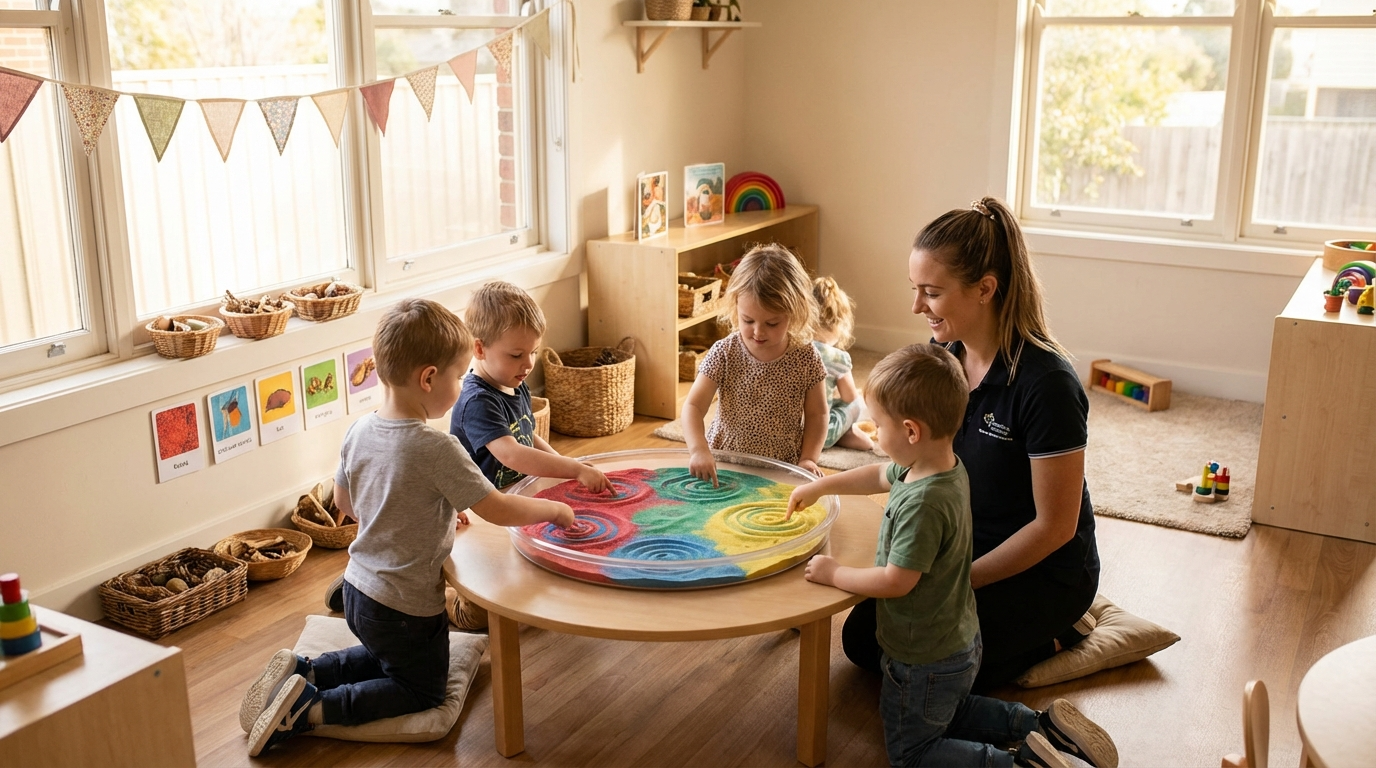
Sensory sound trays are one of the highest-value phonics activities you can run in an EYFS setting — and they cost almost nothing to set up. The core idea is simple: fill shallow trays with sand, rice, or shaving foam, then have children trace graphemes with their fingers while saying the corresponding phoneme aloud. That kinaesthetic-auditory pairing is not a gimmick. The Education Endowment Foundation recognises multi-sensory approaches as an effective strategy for early literacy, precisely because young children consolidate new information through multiple input channels simultaneously. Tactile experience reinforces what the ear hears and the eye sees.
How to Run It
- Introduce the phoneme verbally before children touch the tray — the sound must come first, or they are tracing an abstract symbol with no meaning attached.
- Show a grapheme card as a visual reference while children trace.
- Encourage them to say the phoneme aloud as they write — the simultaneous output matters.
Resources You Need
- Shallow trays (baking trays work well)
- Filler: sand, rice, or shaving foam
- Grapheme reference cards
- Optional: letter stamps or cutters for self-checking
Differentiation
For children who are already secure on individual graphemes, extend the task to CVC words — they trace the full word while segmenting it aloud. This bridges phoneme recognition into blending without needing additional resources. For children who are still building fine motor control, shaving foam is the most forgiving medium; mistakes disappear instantly, which removes anxiety around getting it wrong.
If you want activities like this generated and matched to your current cohort’s development stage automatically, explore how PlayPlan supports EYFS phonics planning — or start your free trial today.
Activity 3: Phonics Puppet Shows
Puppetry is one of the most underused tools in EYFS phonics — and it’s a genuine shame, because the pedagogical case for it is strong. When children have to correct a puppet’s mistakes, they’re not passively absorbing phonics rules. They’re retrieving them, applying them, and articulating them out loud. That’s a completely different cognitive demand.
How It Works
Introduce a class puppet — something simple, like a hand puppet — with a clear rule: this puppet only speaks in words beginning with a target sound. Deliberately have the puppet get it wrong. Say the target is /s/ and the puppet proudly holds up a picture of a dog and says “sog.” Children have to catch the mistake and explain why it’s wrong. That error-correction dynamic is far more demanding than matching letters on a worksheet.
What You Need
- One or two basic hand puppets (nothing elaborate)
- A set of picture or word cards featuring a mix of target and non-target sounds
- A few practitioner script prompts to keep the session moving
The Teaching Tip That Changes Everything
Let children take turns operating the puppet. Once a child is holding it, they become the teacher — choosing which card to pick up, deciding whether to make a mistake on purpose, watching their peers react. That shift in agency turns phonics rehearsal into performance. Children who would never volunteer an answer in a group setting will speak confidently through a puppet. The proxy reduces performance anxiety in a way that direct questioning simply doesn’t.
This is especially worth noting for shy or hesitant learners. The puppet creates just enough distance between the child and the perceived risk of being wrong.
If you want a structured approach to planning phonics activities across the EYFS week, tools like PlayPlan can help you build sessions like this into a cohesive, EYFS-aligned plan without the planning overhead. Start your free trial today.
Activity 4: Phonics Obstacle Courses
Literacy learning does not belong at a table. For kinaesthetic learners and children with high energy or sustained attention needs, a phonics obstacle course reframes the entire experience — movement becomes the pedagogy, not a break from it.
How It Works
Set up stations across an outdoor space or hall, each marked with a laminated phoneme card. At every station, children complete a physical challenge — hop, crawl, balance beam, or jump — and then say a word containing that sound before moving on. No card, no progress. The rule is simple, but the cognitive load is real.
- Resources needed: basic PE equipment or outdoor materials, laminated phoneme cards, optional timer for pacing
- Key tip: attach the phoneme directly to the action — “jump for /j/ words” — so the physical sensation reinforces memory encoding through association
- Integration: slots neatly into existing outdoor learning time with no additional planning required
Why Movement Matters Here
Movement-integrated learning supports attention regulation in ways seated activities simply cannot match for some children. According to the Department for Education, physical activity and EYFS outdoor learning are recognised as core components of early development — not supplementary extras.
If you want activities like this generated and sequenced automatically for your setting, start your free trial today with PlayPlan.
Activity 5: Collaborative Sound Sorting Games
Most phonics activities are designed for individual children, which means they only address one strand of the EYFS at a time. Sound sorting as a group task fixes that. It builds Literacy and Communication and Language competencies simultaneously — a genuine efficiency for busy practitioners.
How It Works
Organise children into small groups of three or four. Give each group a mixed set of picture or object cards and a large sorting mat divided into labelled phoneme sections — for example, /s/, /m/, /ch/, /k/. The task is simple: sort every card into the correct phoneme group. The rule is that everyone must agree before a card is placed.
That agreement requirement is where the learning happens. Children argue, explain their reasoning, and listen to peers — exactly the speaking and listening behaviours the EYFS Communication and Language strand targets.
Resources Needed
- Picture or object card sets (commercially produced or practitioner-made)
- Laminated sorting mats with clear phoneme labels
- Optional: small objects from around the setting to replace cards
The Ambiguous Card Technique
Deliberately include one or two cards that could plausibly belong to more than one group. The classic example is ‘chip’ — does it start with /ch/ or /k/? There is no trick; the point is to provoke genuine discussion and higher-order thinking. Children who reach a reasoned consensus on an ambiguous item have done far more cognitive work than children who matched an obvious card without hesitation.
Peer Scaffolding Without Practitioner Intervention
The collaborative format naturally leverages ability differences within the group. More confident readers tend to explain their thinking aloud, which gives less confident peers a model to follow — without the dynamic feeling like top-down instruction. Your role shifts from deliverer to observer, which also creates better assessment opportunities.
For practitioners who want to plan EYFS phonics activities efficiently without building every resource from scratch, tools like PlayPlan can generate ready-made card sets and sorting mat templates aligned to specific phoneme targets. Start your free trial today.
EYFS Alignment
This activity directly addresses EYFS Literacy (word reading) through phoneme recognition and Communication and Language through structured peer discussion — two areas of learning in a single twenty-minute session.
Activity 6: Story-Led Phonics Sessions and Activity 7: Phonics Art Provocations
These two activities represent the strongest argument for play-based phonics in EYFS. When phonics is embedded inside narrative and creative expression, children stop experiencing it as a subject entirely. It becomes a medium — something they move through, not something done to them.
Activity 6: Story-Led Phonics
Choose a picture book with strong phonetic repetition. Books with alliterative characters or recurring sound patterns work particularly well — think of titles where a character’s name, actions, and setting all share a dominant phoneme. This isn’t accidental in good picture books; authors use it precisely because children respond to it instinctively.
The session structure is simple but deliberate:
- Read aloud with full expression, not yet pausing for phonics instruction.
- On a second pass, stop at phonetically rich moments — isolate the sound, say it clearly, invite children to spot it elsewhere on the page.
- Build a shared word wall as you go, using sticky notes with words or images representing sounds found in the story.
- Use phoneme prompt cards to extend beyond the book — can children think of words from their own lives that carry the same sound?
Resources needed: A carefully selected picture book, sticky notes or a designated word wall space, phoneme prompt cards.
Practitioner tip: Re-read the same book across several days. Some practitioners worry this feels repetitive, but repetition is not boredom for young children — it is consolidation. Each re-read deepens familiarity, and children begin to anticipate the phonemes, which is itself a sophisticated pre-reading skill.
Why Narrative Is the Most Natural Phonics Scaffold
Children arrive in EYFS already understanding, intuitively, that sounds in stories carry meaning. A growling monster sounds different from a whispering fairy. Embedding phonics instruction inside narrative leverages this existing cognitive framework rather than asking children to build a new one from scratch. The phoneme is no longer an abstract unit — it belongs to a character, an event, a feeling. That emotional anchoring is what makes the learning stick beyond the session.
Activity 7: Phonics Art Provocations
Give children a phoneme and invite them to create artwork representing objects, creatures, or characters whose names begin with — or contain — that sound. The art itself is the thinking. Once pieces are complete, the practitioner scribes labels collaboratively with each child, naming what they’ve made and reinforcing the phoneme in context.
Resources needed: Open-ended art materials, phoneme reference cards, labelling strips or sticky notes.
Practitioner tip: Display the finished work with the target phoneme prominently visible alongside each piece. The environment becomes a teaching resource, and children revisit the learning every time they notice their work on the wall.
Art as Phonics Evidence: What to Look For
This activity is particularly valuable for observation and documentation. Watch for children who self-correct their artwork when they realise an object doesn’t match the sound — that moment of self-regulation is significant. Note whether children make the phoneme sound spontaneously while drawing. Record instances where children label independently, even approximately. These observations map directly onto EYFS documentation requirements across both Literacy and Expressive Arts and Design.
That cross-area reach matters practically. Activity 7 simultaneously addresses Communication and Language, Literacy, and the Expressive Arts and Design area of the EYFS framework. For time-pressured practitioners, activities that justify their place across multiple EYFS outcomes are the most planning-efficient investments you can make. One well-designed provocation earns its time several times over.
This is the broader argument these two activities make together: when phonics lives inside story and creativity, children stop enduring it and start inhabiting it. That shift — from compliance to curiosity — is not incidental. It is the whole point. If you want to plan EYFS phonics activities that deliver this kind of integrated learning without the hours of preparation, start your free trial today.
Fitting These Activities Into a Realistic EYFS Day
The honest objection most practitioners have isn’t “these activities don’t work” — it’s “where exactly does this fit between snack time and outdoor provision?” The good news is that most play-based phonics activities don’t need a dedicated literacy slot. They work as continuous provision enhancements, transition fillers, or focused small-group moments. The structure of your day doesn’t need rebuilding — it needs deliberate embedding.
What actually costs time isn’t delivering the activity. It’s everything before that: sourcing the right resources, writing clear instructions for a support worker, checking EYFS alignment, and differentiating for the three-year-old who’s just starting to tune in to initial sounds versus the four-year-old blending CVC words confidently. That planning load — repeated weekly — is where practitioners lose hours they don’t have.
This is where AI-assisted EYFS planning tools shift from novelty to necessity. Generating a differentiated phonics activity with a resource list, setup instructions, and tagged EYFS objectives takes minutes, not an evening. PlayPlan is built specifically for this: it handles the planning infrastructure so practitioners can focus on the actual teaching.
If you’re spending Sunday evenings building next week’s phonics provision from scratch, start your free trial today and let PlayPlan generate EYFS-aligned activity plans in the time it takes to make a coffee.
The Practitioner’s Role: Facilitator, Not Instructor
Every activity described in this article falls flat without one thing: a practitioner who is genuinely present. Sound hunts, sorting games, puppet sessions — none of them deliver their potential when someone is working through a checklist. They come alive when the adult is watching, listening, and knowing exactly when to extend a child’s thinking with a well-timed question or a deliberate provocation.
That presence has a prerequisite: headspace. When planning is handled efficiently — whether through smart templates or AI-powered activity planning tools — practitioners carry less administrative weight into the room. That cognitive bandwidth is not a luxury. It is what allows you to notice that a child said “sssnake” with unusual emphasis, and to build tomorrow’s session around that moment.
Documentation gathered during these activities — the exact words a child uses during a sound hunt, the sorting logic they explain unprompted — is richer assessment evidence than any worksheet could produce. It reflects real understanding in context.
Ultimately, phonics is not a subject imposed on children. It is the moment a child realises that the sounds they have been making since birth have shapes, patterns, and power. Practitioners who understand that are not delivering a programme — they are opening a door. If you want to plan with that kind of intention behind every session, start your free trial today.
Bringing It All Together: What Play-Based Phonics Actually Delivers
Seven activities, one argument: phonics in EYFS works best when it is indistinguishable from the play, story, movement, and creative expression that already define a child’s day. The evidence for this is not tentative. Phonemic awareness precedes grapheme-phoneme correspondence, and the activities that build it most reliably — sound hunts, sensory trays, puppet error-correction, collaborative sorting, story immersion, art provocation, physical phonics — are all rooted in exactly the kinds of multi-sensory, socially embedded experience that EYFS is designed to prioritise.
There are genuine trade-offs worth acknowledging. Play-based phonics requires more thoughtful design than handing out a worksheet. It demands practitioners who are present, observant, and responsive rather than simply delivering a script. And it requires planning that is specific enough to be purposeful without being so rigid that it prevents the child-led moments where the deepest learning actually happens. None of that is easy to sustain week after week, particularly in settings where time and staffing are constrained.
But the alternative — rote drills, decontextualised flashcards, phonics as a subject separate from everything else — carries its own cost. Children who experience phonics as something done to them, rather than something discovered through play, are more likely to disengage, and that disengagement has documented downstream effects on reading confidence and attainment. The short-term convenience of a low-prep drill is not worth the medium-term cost of a child who associates letters with anxiety.
The clear recommendation this article makes is this: design phonics into your provision rather than onto it. Start with the activities your children already love — the construction area, the role-play kitchen, the outdoor space, the book corner — and find the phoneme opportunities already inside them. Use story as your most powerful scaffold. Let movement carry the learning when seated attention runs thin. Give children the agency to be the teacher, the artist, the investigator. And where the preparation burden is real, use tools designed to reduce it.
Phonics built this way does not just teach letter-sound relationships. It builds the social confidence, creative thinking, and cognitive flexibility that make literacy stick — and those foundations, once laid, carry children far beyond the early years setting into a lifetime of engaged reading and communication.